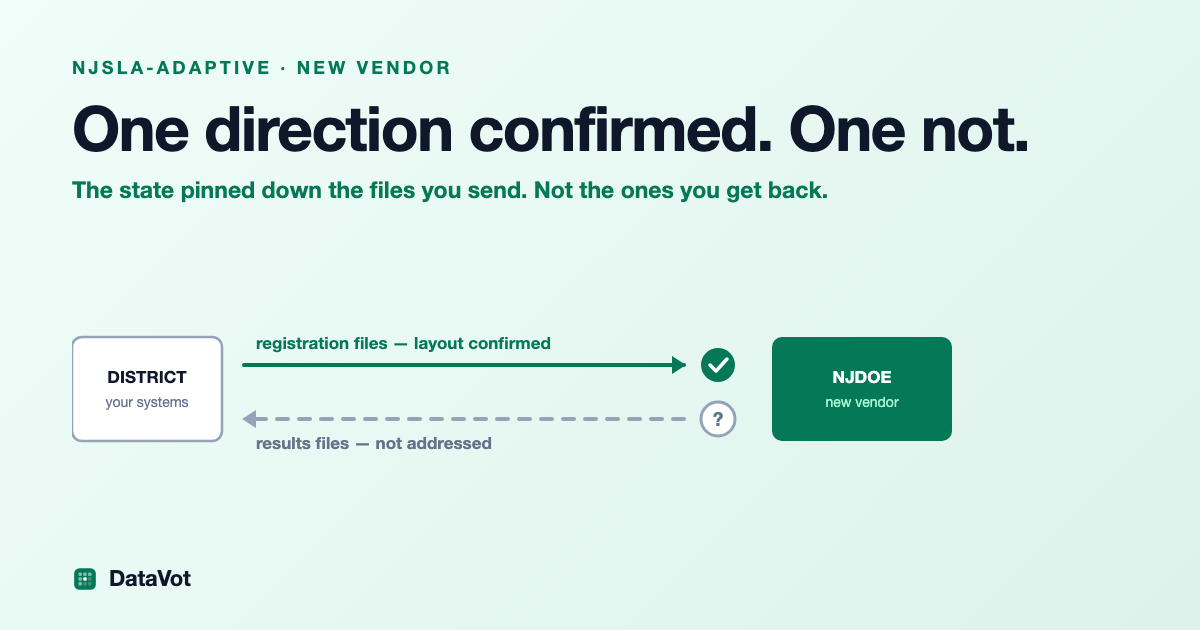
Who this is for: New Jersey district test coordinators, data managers, and the people who maintain whatever spreadsheet or system consumes state assessment results each year. New Jersey changed assessment vendors for 2025–26. The state has been clear about what that means for the files districts send in. It has said nothing public about the files districts get back, and those are the ones every downstream workflow depends on.
What the state actually confirmed
When the vendor change was announced in August 2025, the obvious district worry was whether existing file plumbing would survive it. NJDOE answered that worry directly, in a State Assessment Vendor Update on the NJSLEDS site:
"At this time, the shift to a new vendor does not affect the structure of State Assessment Registration (SAR) submissions in NJSLEDS. All districts should continue to use the existing SAR submission templates and guidance. No changes have been made to the file layout, required data elements, or validation rules."
That is a real, useful, specific commitment, and it is worth noticing how specific it is: it names the file layout, the required data elements, and the validation rules by name. Someone on the state side understood exactly which details a district has to have pinned down before it can plan anything.
It also covers exactly one direction of travel: registration data going up.
The other direction
A district's year does not end when registration is submitted. Results come back, and historically they have come back in two forms: fixed reports meant to be read, and a student-level data file meant to be worked with. The second one is where the actual analysis happens — the file behind every multi-year comparison, every subgroup breakdown, every "which schools moved" conversation in September. We have written before about how much sits in that file and how rarely it gets opened.
So what will that file look like this year?
NJDOE has published what the reports will contain. The NJSLA-Adaptive FAQ says student score reports will provide "information about an individual student's performance, including overall achievement levels, scale scores, reporting category performance, growth (when available), and comparisons to school, district, and state averages," and that aggregate reports will summarize results by group.
That is a description of content. It is not a description of delivery.
Checked on 2026-08-20, across the three public pages a district would actually look at — the assessment homepage, the NJSLA-Adaptive landing page and the FAQ — none of the following appears anywhere: data file, CSV, file layout, student data file, download, or score interpretation guide. The words the vendor update used so precisely about submissions do not appear at all about results.
Why this is a planning problem rather than a complaint
None of this means the file is changing. It may well arrive looking much as it always has. The point is narrower: a district cannot currently tell, and the season for finding out is short.
Three things make the uncertainty concrete rather than theoretical.
The vendor changed. File formats are vendor artifacts. A new vendor's reporting platform exports what that platform exports, and continuity is a decision someone has to make and publish, not a default. NJDOE made and published exactly that decision for submissions, which is what makes its absence for results conspicuous rather than merely unmentioned.
The scale changed. The performance levels are being newly set, and NJSLA-Adaptive reports five levels for ELA and mathematics while NJGPA-Adaptive reports two — Graduation Ready and Not Yet Graduation Ready. Any file that carries a level column now carries a different set of values than the file that carried it before, whatever the column is named.
Column names already drift between years even without a vendor change. That is not speculation; it is the problem we have already written up, where a field holding performance level in one year's export is labeled differently in another. A vendor transition is exactly the kind of event that makes it more likely, not less.
What is known about timing
The delivery schedule is better documented than the delivery format. NJDOE's July 2026 standard-setting presentation says Fall 2026 NJGPA-Adaptive results are "anticipated to be returned to districts before winter break," and Spring 2027 NJSLA-Adaptive results are "anticipated to be provided to districts by June 30, 2027 — this represents results being delivered almost two months earlier than prior years." It also notes that results follow a student across district transfers and that districts can roster students over the summer.
So a district knows roughly when. What it does not know is what shape the thing arriving will be in.
What to do about it now
Write down what you currently consume. Not "we get the NJSLA file" — the actual list: which columns feed which report, which ones a formula or a script depends on by name, which ones a person retypes by hand every year. Most districts have never written this down, and the year a format changes is the worst possible time to reconstruct it from memory.
Separate reading from processing. The fixed reports and the raw file fail differently. A report that looks different is an inconvenience for the person reading it. A file whose columns moved is a broken workflow, and it breaks silently — a lookup that returns blanks looks like missing students rather than a renamed header.
Ask, in writing, before results season. The question is answerable and specific: will the student-level results file for Spring 2026 keep the same layout and field names as prior years, and will a file layout or score interpretation guide be published before results are released? A vendor update already exists that answers precisely this question for submissions. Asking for its counterpart is not an unreasonable request.
Plan for a mapping step regardless. Assume you will need to align this year's columns to last year's at least once. Budget an afternoon for it in September rather than discovering it in the middle of a board-report deadline.
The state has told districts, clearly and in writing, that the files they send have not changed. That was the right thing to publish, and it is the reason the silence on the other half is worth noticing. Districts do not need a guarantee that nothing changed. They need to know which it is, early enough to do something about it.