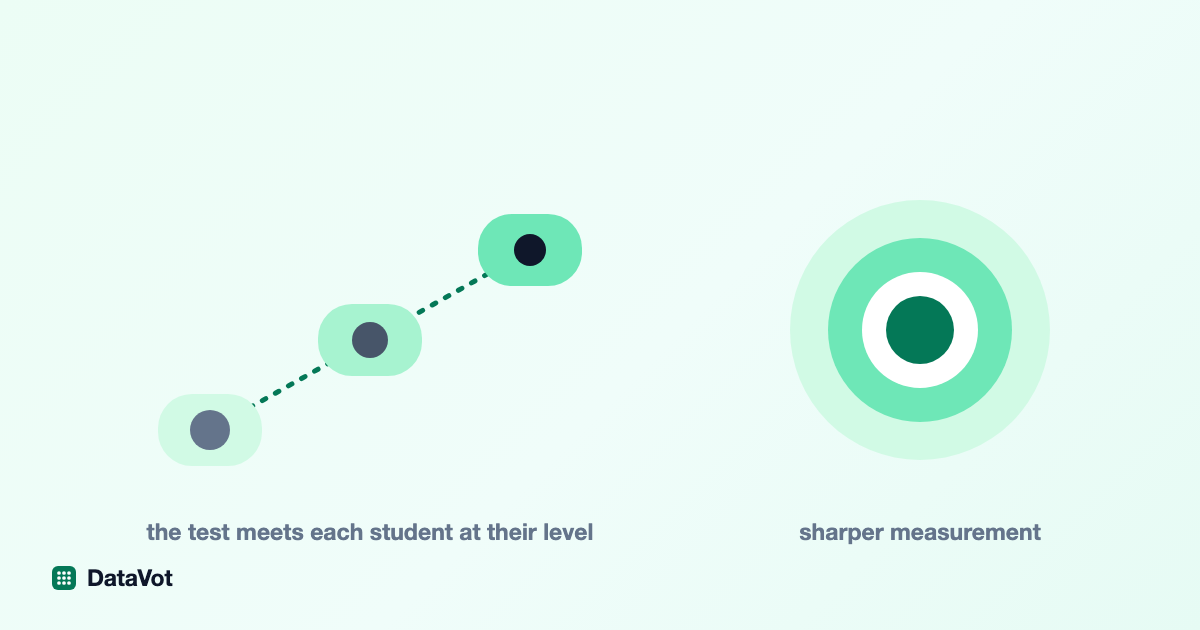
For years, New Jersey's statewide ELA and mathematics tests used fixed forms: students in the same grade answered the same questions, whether the material was too easy, too hard or about right for them. A single fixed test cannot respond to the range of students taking it.
In spring 2026 the NJSLA-Adaptive (NJSLA-A) replaced the fixed-form NJSLA. This article, written for teachers and curriculum directors, makes the measurement case for it: what an adaptive design can do better, and where its limits are. How the test picks each group of questions is explained in How the NJSLA-Adaptive Algorithm Decides. The objections are in The Great NJSLA-Adaptive Debate. The graduation test, the NJGPA-Adaptive, is a different test and is not covered here.
From a static yardstick to a responsive one
A fixed test is a bit like a ruler with markings only around the middle. It still produces a measurement, but the farther a student sits from that middle range, the less the reading tells you. An adaptive test moves the markings toward the student. According to the NJDOE FAQ, the test begins with items of medium difficulty and becomes more or less challenging based on how the student answers each set, so a student receives more items closer to their current level.
The aim is precision within the grade-level standards, not a diagnosis of every skill. NJDOE says the NJSLA-A determines students' grade-level proficiency in the New Jersey Student Learning Standards and is "not designed for frequent progress monitoring or instructional adjustments." It does not replace classroom assessment or instructional diagnostics. What it offers is a sharper measure of how students perform against common standards, using the student's own responses.

A test that matches the student more closely
A fixed form can put a struggling student through a long run of discouraging questions and give an advanced student many questions that reveal little about what they know. An adaptive test is designed to reduce that mismatch. NJDOE describes this as a benefit to students: questions closer to their current level can help reduce testing anxiety and encourage confidence and focus.
That does not make the test easy, and it does not turn it into an individualized learning program. It means the test responds to evidence gathered during the session instead of treating every student as if they arrived at the same place.
More information from every response
The main measurement argument for adaptive testing is better targeting. A question far too easy or far too hard for a student tells the test little about that student. Questions near the student's level tell it more. An adaptive test spends more of its questions where they are informative for each student.
The design also keeps the standard fixed. The FAQ lists why the test is fair even though students see different questions: everyone is tested on the same standards, difficulty adjusts but content does not, only grade-level items count toward the score, and all items are pretested and calibrated. For testing times and units, see NJDOE's unit testing times page.
What the results will report
A more precise test does not bring results sooner in its first year. The state had to set new performance standards and cut scores and get State Board approval before reporting any scores. The FAQ lists Spring 2026 NJSLA-A results for fall 2026, and they had not been released when this article was written. For later years, the FAQ lists Spring 2027 NJSLA-A results for June 30, 2027.
NJSLA-A reports carry an overall performance level on five levels, from Did Not Yet Meet Expectations to Exceeded Expectations, and results by reporting category, each marked Below Expectations, Near or Within Expectations or Above Expectations, per the NJSLA Score Interpretation Guide. NJDOE describes the reports as "most useful when viewed alongside classroom performance and other indicators of student learning." The statewide test is one source among several, and it can be a more informative one than before.
A more interactive digital test
The NJSLA-A is computer-based. The FAQ lists digital tools and accommodations, including highlighting and digital notetaking, text-to-speech, speech-to-text response and zoom, and a range of interactive item types. The mathematics tests use only machine-scorable item types. The full list of item types and sample items is on the practice tests.
Interactive formats let students show mathematical thinking in more ways than choosing one answer from a list. That widens what a statewide test can observe.
Adaptive does not mean everything changes
The adaptive design applies to ELA Reading and Mathematics. The FAQ says the writing unit "is not adaptive because it includes only one extended writing task," scored with a holistic rubric on two dimensions, Conventions and Composition. The rubrics are published.
So New Jersey did not hand every part of the test to an algorithm. It uses adaptive measurement where the format suits it and keeps a direct writing task where students need to show extended written communication.
The case, and its limits
Adaptive testing cannot replace a teacher's knowledge of a student, explain why a child struggled with a concept, or substitute for classroom observation, intervention or diagnostic testing. NJDOE does not claim it can.
What it can do is make a statewide test more responsive to the student taking it while keeping a common measure against New Jersey's standards. It is designed to give every student the same standards and a more precise reading against them, and NJDOE does not claim it replaces the classroom context teachers supply. Whether it delivers is a question for the results themselves, and for how well they match what teachers already know about their students. One caution applies before anyone compares those results with prior years: NJDOE's standard-setting presentation states that the change "introduces a new scoring scale."
Related reading: The Great NJSLA-Adaptive Debate · How the NJSLA-Adaptive Algorithm Decides