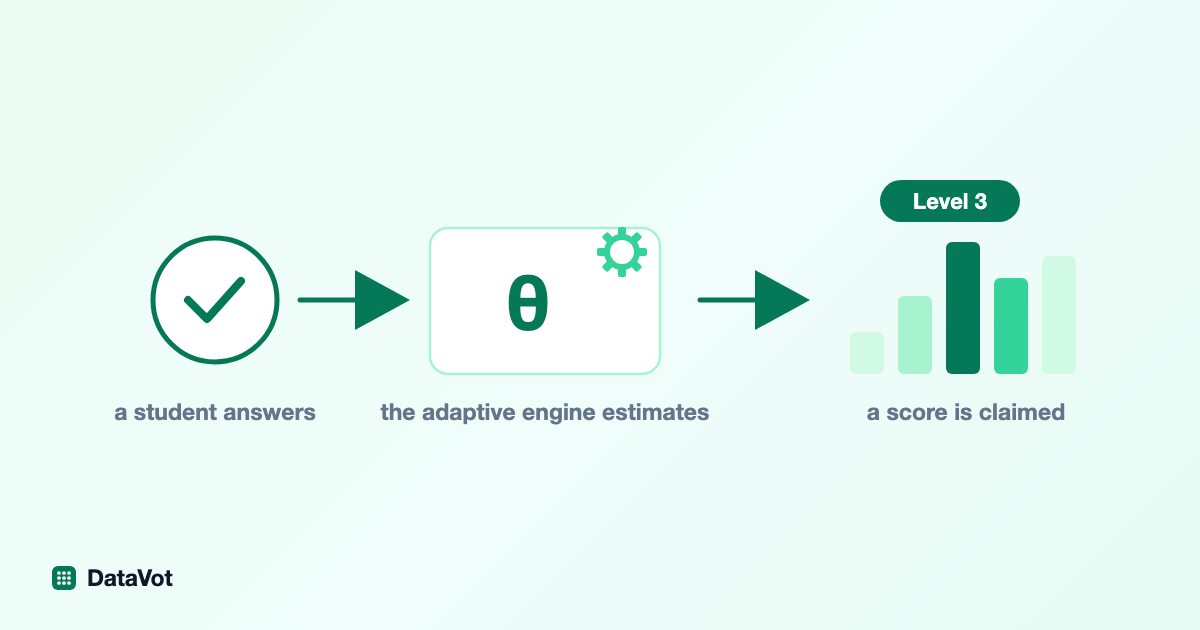
New Jersey has told educators that its new statewide assessments are adaptive and precise. As teachers work with the NJSLA-Adaptive (NJSLA-A), one basic question keeps coming up: how does the test decide which question a student sees next?
For teachers, knowing how an assessment works is part of knowing what its results mean. If two students in the same class answer different questions, and those questions produce the scores used to describe their performance, educators have a fair interest in how the questions are chosen, how they are calibrated, and how the state keeps the result fair. NJDOE has answered some of this. This article sets out what it has said, and what educators would need to see to evaluate the rest.
How the test chooses questions
The simple picture of adaptive testing is a seesaw: answer correctly and the next question gets harder, answer wrong and it gets easier. That is roughly right, with one important difference in New Jersey's version.
According to NJDOE's NJSLA-Adaptive and NJGPA-Adaptive FAQ, the test "begins with items of medium difficulty and becomes more or less challenging depending on how the student answers each set." It "does not adjust after a single item." Working in groups of questions gives a more precise estimate of performance while the test still measures grade-level standards.
The FAQ also explains where an item's difficulty comes from. It is "determined after field testing": items that more students answered correctly are labeled easier, and items with lower correct-response rates are labeled harder. Adaptive tests are typically calibrated with statistical models from item response theory, which also estimate how well an item separates stronger from weaker students. NJDOE has not published which model New Jersey uses or the statistics behind it.
Two more rules from the FAQ shape what the engine can do. Everyone is tested on the same standards, with difficulty adjusting but content staying the same, and "only grade-level items count toward the score." And once a student answers an item, it does not re-adapt, which is why the state advises students to give their best answer to each question rather than rush ahead.
Where the questions come from
The engine does not write questions. It selects them from a pool that has already been through a long review process. The FAQ lists the stages, and New Jersey educators take part at several of them:
- Selection and NJDOE review of reading passages
- Educator review of passages for bias, sensitivity, and content
- Item writing, with review by the vendor and by NJDOE
- Educator committee reviews for bias and sensitivity and for content alignment
- Rubric validation by educators
- Field testing, scoring, and educator review of the item data
Only then does an item become operational.
The field test had a cost for schools
The fall 2025 field test is where much of that calibration happened. NJDOE told districts in its August 2025 field-test broadcast that no results would go back to students, educators, or schools, because the purpose was "to evaluate the quality and performance of test items—not to measure student achievement."
Field testing is standard practice: new items cannot be used before they are tried. But for the teachers who gave it, the field test used class time on an assessment that was never going to report anything back to them. The state could reasonably follow up by explaining what the field test showed, including whether items were dropped or revised because of it.
How a score becomes a performance level
The adaptive engine produces an estimate of each student's performance on a scale. That number means little to a parent until it is turned into one of the five NJSLA-A performance levels: Did Not Yet Meet, Partially Met, Approaching, Met, or Exceeded Expectations. On the fixed-form NJSLA, NJDOE's School Performance Reports reference guide counted a student as proficient at Level 4 (Met) or Level 5 (Exceeded). The same line holds on the NJSLA-A: the 2026 NJSLA Score Interpretation Guide says its Percent Proficient column “shows the percentage of students who are in the ‘Met Expectations’ and ‘Exceeded Expectations’ performance levels.”
The conversion is not automatic. It comes from standard setting, where panels of educators decide where each level begins. NJDOE's standard-setting presentation to the State Board of Education in July 2026 describes the process: panels work from ordered booklets of items built from actual Spring 2026 student responses and go through structured rounds of judgment and discussion to recommend cut points. The FAQ adds that standard setting "is not a yearly event" and happens only when a test changes significantly or a new one begins.
If NJDOE keeps the fixed-form definition, the line that matters most for a district is the one between Level 3 and Level 4, because it decides the proficiency rate. The State Board adopted cut scores for the NJGPA-A, the graduation test, on August 5, 2026. When this article was written, the NJSLA-A cut scores and results had not been released; NJDOE listed the results for fall 2026.
How writing is scored
The writing part of the test is not adaptive, because it is a single extended writing task. According to the FAQ, it is scored with a holistic rubric on two dimensions, Conventions and Composition, and NJDOE has published the NJSLA-A and NJGPA-A writing rubrics.
The FAQ describes one quality check for the graduation test. On the NJGPA-A, writing from students who scored within two scale-score points of the 450 cut score and received the lowest possible score on both rubrics is automatically reviewed by an additional human scorer. NJDOE's July presentation also said results were later partly because of "the extensive hand scoring of the ELA writing prompts this year." The state has not published a fuller description of the writing scoring process, or of quality checks for the NJSLA-A.
That is a reasonable thing for a district to ask about. A clear rescoring route matters because it shows that the system expects to make occasional errors and has a way to catch them.
Transparency does not mean publishing the item pool
Asking for transparency does not mean asking the state to publish its operational questions or every item-selection rule. Releasing the item pool would compromise the test, and there are sound security reasons for keeping it private.
What educators need is enough documentation to understand and check the method:
- How item statistics are estimated from field-test data
- How the adaptive path keeps content balanced across the standards
- How different students' paths are placed on one comparable scale
- How standard-setting panels were chosen and how the cut scores were set
- How writing scoring quality is monitored, and how rescoring works
- How items that perform poorly are removed or revised
The real test of transparency comes after the results
With the first operational administration done, the state now has real data. Once NJSLA-A results are released, New Jersey can show how well the test worked as well as how it was meant to work: how items performed, how the test performed across student groups, how the new scale was built, and how it relates to past results. How that last question could be answered is covered in When a Test Changes.
Teachers do not need to become psychometricians. But they should know enough to explain the test to students, read the results responsibly, and recognize what the results cannot tell them. Having questions about the engine is not evidence that it is flawed. Having an FAQ is not evidence that every question is settled.
The goal is trust that can be checked: documentation clear enough that the educators who use the results can understand the system and question it. That does not require the source code. It requires the evidence.
Related reading: The Great NJSLA-Adaptive Debate · From PARCC to Adaptive: A Decade of Change in New Jersey State Testing