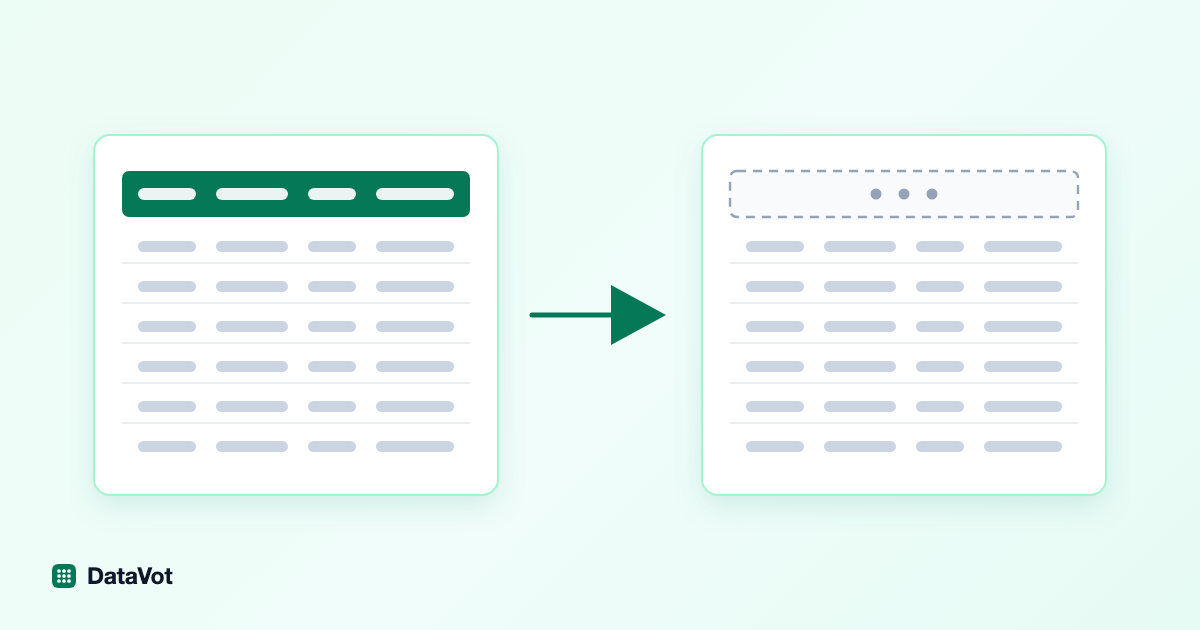
When a district buys anything built to order, the first question is what it will actually receive: not the approach or the methodology, but the list of things that get handed over. A statewide assessment is bought to one specification for every district in the state, so its deliverables ought to be easy to pin down. New Jersey did pin them down. Its own bid solicitation names them one by one.
What that document does not do is say what shape they arrive in, and every district workflow is built on the shape. This matters most to district test coordinators, data managers, and whoever maintains the spreadsheet or system that consumes state assessment results each year.
The deliverables are specified, and the list is public
New Jersey procured its new assessment program through Request for Quotes #25-004, issued by NJDOE on October 15, 2024. Its contract terms define a deliverable as "Goods, products, Services and Work Product that Contractor is required to deliver to the State under the Contract." Approving all of them falls to one named role, the State Contract Manager (SCM).
Reporting is split into two cycles. For the first, the RFQ says:
"In the first phase, individual student reports for each assessment, student rosters, school and district roster summaries, and school and district summary reports along with a downloadable student level data file shall be released to school districts by a date approved by the SCM each year for the spring administration."
The second cycle adds aggregate score reports including federally required subgroups, summary reports by reporting category, an item analysis report, a State Summary Report, and a score interpretation manual, which "shall be made available on the Contractor's assessment website." A separate state summary downloadable data file must carry "at a minimum, the number and percent of General Education, Multilingual Learner (current and former), Special Education students, demographic categories, and other State and federally required student reporting categories".
So a district knows its list: individual student reports, rosters, roster summaries, school and district summaries, aggregate reports, an interpretation manual, and a downloadable student-level data file. That last item gets talked about least, yet it is the file behind every multi-year comparison and every subgroup breakdown. We have written about why districts rarely act on that file.
The contract does not specify the format
The section covering results data files delivered to the state tells the contractor to "determine the format of these files, in conjunction with the SCM," and to "send the record layout to the SCM prior to the test administration".
Two things follow. First, the format was not fixed in advance. The vendor and the state settle it after award, and nothing in the document requires continuity with what districts received before.
Second, every mention of a record layout in the RFQ points to the SCM. The phrase appears three times, and all three are deliveries to the state: the results data files, the pupil score CDs, and the school and district summary. The district-facing student-level data file is named as a deliverable and given a release timeline, but no layout, data dictionary, or field list is required for it anywhere in the document. The only layouts the contract requires go to Trenton, and nothing in it obliges anyone to publish a description of the file districts actually open.
Where the RFQ showed bidders what New Jersey's reports look like, it linked to the previous vendor's report samples and the Spring 2022 NJSLA Score Interpretation Guide. Those set a reference for the quote. They are not a published commitment that what a district opens now will resemble them.
What NJDOE has published since the award
NJDOE has described what the reports contain. Its NJSLA-Adaptive and NJGPA-Adaptive FAQ explains the overall performance levels and the reporting categories, and points to "each assessment's respective score interpretation guide." The NJDOE adaptive assessments page now links both an NJSLA Score Interpretation Guide and NJSLA sample Individual Student Reports, alongside the NJGPA-A equivalents. The NJSLA guide names the NJSLA-A reporting-category levels: Below Expectations, Near or Within Expectations, and Above Expectations.
Results are delivered through NJDOE's Centralized Reporting System (CRS). NJDOE's September 9, 2026 broadcast describes CRS as "the reporting system used to access the NJSLA-A and NJGPA-A assessment results and reporting resources," and its training covers "how to access the Individual Student Reports (ISRs) and aggregate school and district reports."
Timing is documented too. The FAQ lists release dates for each test separately: Spring 2026 NJGPA-A results on August 17, 2026, and Spring 2026 NJSLA-A results in "Fall 2026," followed by dates for the 2026-27 administrations. Check the FAQ for the current schedule.
What none of these documents describes is the student-level data file: its columns, field names, or whether it keeps the layout districts used before. The reports are explained. The file is not.
The state has answered this question once before
It answered it for data going the other direction. When the vendor change was announced in August 2025, NJDOE told districts whether their registration files would still work, in a State Assessment Vendor Update on the NJSLEDS site:
"At this time, the shift to a new vendor does not affect the structure of State Assessment Registration (SAR) submissions in NJSLEDS. All districts should continue to use the existing SAR submission templates and guidance. No changes have been made to the file layout, required data elements, or validation rules."
That statement names the file layout, the required data elements, and the validation rules, because someone at the state understood what a district needs pinned down before it can plan. The results coming back have no equivalent statement.
Why it matters this year
None of this means the file is changing. It may arrive looking much as it always has. A district simply cannot tell yet, for three reasons.
The vendor changed. File formats are vendor artifacts, and continuity is a decision someone has to make and publish. The RFQ left that decision until after award.
The scale changed. The NJSLA-A reports five performance levels for ELA and mathematics, set through a new standard-setting process. The NJGPA-A, a different test, reports two: Graduation Ready and Not Yet Graduation Ready. Any level column now carries values set on a new scale, whatever the column is named.
Column names drift between years anyway. A field holding performance level in one year's export can be labeled differently in another, as covered in Comparing NJSLA Results Across Years. A vendor change makes that more likely.
What to do now
Write down what you currently consume. List which columns feed which report, which ones a formula or script depends on by name, and which ones a person retypes by hand. The year a format changes is the worst time to reconstruct that from memory.
Separate reading from processing. A report that looks different is an inconvenience. A file whose columns moved breaks a workflow silently: a lookup that returns blanks looks like missing students rather than a renamed header.
Ask for a field list, in writing. Ask the Office of Assessments (assessment@doe.nj.gov) whether a data dictionary exists for the student-level data districts receive through CRS, and whether its field names match prior years. The contract required the vendor to document the layout of the files it sends the state; the request is for the same kind of description of the file districts receive.
Plan for a mapping step regardless. Assume you will need to align this year's columns to last year's at least once, and budget the time before your board-report deadline rather than during it.
New Jersey did the hard part: it specified the deliverables and named them individually, and it required record layouts for the files the state itself receives. Describing the district file the same way is a small step by comparison. Districts do not need a promise that nothing changed. They need to know whether it did, early enough to act.