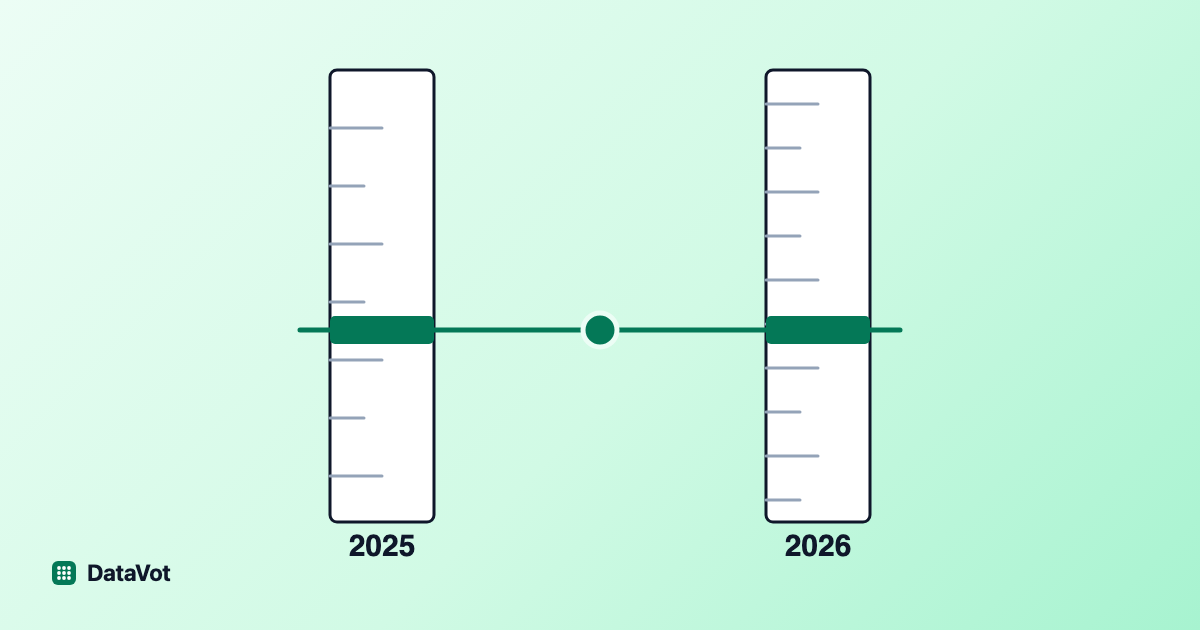
A New Jersey district preparing to discuss this year's results has a reasonable worry. The NJSLA-Adaptive (NJSLA-A) replaced the fixed-form NJSLA in spring 2026, and NJDOE's July 2026 standard-setting presentation to the State Board says the change “introduces a new scoring scale” and that “prior fixed-form cut scores from the NJGPA and NJSLA no longer apply”. If last year's scale and this year's are not the same ruler, it is natural to assume that growth, which compares a student now to a student then, stops working.
It does not, and NJDOE has said so in its own FAQ.
NJDOE's answer
The NJSLA-Adaptive and NJGPA-Adaptive FAQ asks: “With the changing of the statewide assessments, will median Student Growth Percentiles (mSGP) still be calculated for the 2025-2026 school year?”
Yes, mSGP can still be calculated regardless of the assessment administered because Student Growth Percentiles (SGPs) measure a student's relative growth compared to their “academic peers” over prior years.
A follow-up question in the same FAQ explains why:
Because SGPs measure growth relative to academic peers, they can still be calculated when assessments change. Differences in score scales, scoring methods, or test formats do not prevent growth from being measured.
Read closely, the answer does not say the new scores are comparable to the old ones. It says the growth measure does not depend on that comparison.
Why a relative measure survives a new scale
An SGP is not a distance. NJDOE defines it as “a percentile ranking from 1 to 99 which explains a student's academic progress compared to their academic peers,” and it defines those peers as “all students in New Jersey in the same grade level who took the same previous assessments in the last year or two and had similar scale scores on those assessments.” The FAQ puts it the same way: an SGP “does not compare the change in an individual student's performance from one year to the next.”
The comparison group is built from prior scores, which all sit on the old scale together. The ranking is done on current scores, which all sit on the new scale together. The calculation never subtracts a 2026 score from a 2025 score. It asks: among the students who looked like this one last year, where did this one finish this year?
A new scale changes what a scale score means. It does not stop students being ranked against each other on it.
New Jersey has lost growth data before, for a different reason
Growth was missing from the School Performance Reports for three years. When it returned, NJDOE explained why it had gone:
…the 2022-2023 School Performance Reports will include student growth data for the first time since 2018-2019. The NJDOE’s measure of student growth requires both current-year assessment results and at least one prior year’s results, but growth data could not be reported in recent years because the New Jersey Student Learning Assessments (NJSLA) were cancelled in 2019-2020 and 2020-2021 due to the COVID-19 pandemic.
What broke growth then was a missing administration, not a changed test. Growth needs two points, and cancelling a year removes one of them. Changing the instrument used for the second point does not. Expect someone in a board meeting to treat every disruption as the same kind; this is the distinction to bring.
What still has to be true
The existing eligibility rules did not relax, and they are where a district will actually lose students and teachers from the count.
- Two consecutive grade-level assessments. NJDOE states that “only students who take two consecutive grade-level assessments will receive an SGP.” A student who did not test last spring has no peer group this spring.
- Grades 4 through 8 only. NJDOE’s explanation of median SGPs states that students in grades 4 through 7 receive an SGP in both ELA and mathematics, and that grade 8 is different: “Students in grade 8 only receive an SGP for ELA because many students take the Algebra I assessment in grade 8 instead of the Math 8 assessment.” Grade 3 is the first testing year, so there is no prior point to grow from.
- Twenty students, 70 percent of the year. For a teacher to receive an mSGP, NJDOE’s mSGP page requires valid SGP scores for at least 20 separate students enrolled in the class for at least 70% of the year before the assessment, in an eligible ELA or mathematics assignment. The page states that rule for the 2023-2024 school year, and it is the most recent version NJDOE has posted, so confirm it still applies to 2025-2026.
None of that is new. All of it is easier to get wrong in a year when rosters, identifiers and the testing platform all changed at once.
Three things NJDOE has not answered
The FAQ answers whether the calculation can be performed. It does not say what the resulting numbers should be used for.
Whether this year's growth can be compared with last year's. A 55th-percentile SGP in 2026 was produced by ranking students on a scale that did not exist in 2025. Nothing published says a district may put the two side by side and read the difference as improvement. The same caution applies to proficiency rates; see When a Test Changes: What Would Show That "Proficient" Still Means the Same Thing?
What the timing will be. The 2024-2025 mSGPs were released on November 19, 2025, with the certification window closing on January 2, 2026 and Corrective Action Plans due within 25 working days of that date. This year the FAQ lists the Spring 2026 NJSLA-A results only as “Fall 2026,” later than in past years. Whether the evaluation calendar moves with them is not in the published record, and a district would rather ask now than in December.
How the three-year rule behaves across the break. The same November memo states that teachers with at least three consecutive years of mSGP data earn a score based on their current year or the median of the three combined, whichever is more advantageous. For 2025-2026 that median would combine one year of growth measured across a scale change with two measured within a single scale. That follows from reading the two rules together, not from anything NJDOE has published about it, so treat it as a question to raise rather than a finding. A testing coordinator is well placed to raise it.
What to do now
Keep the two claims apart before anyone merges them.
Proficiency rates: the scale changed and the cut scores were reset, and NJDOE has not published a study linking the new scale to the old one. A district cannot claim that a change from 2025 to 2026 measures a change in achievement. Growth percentiles: still calculated, by NJDOE's own account. A slide that tells these as one story will be wrong about at least one of them.
Before NJSLA-A results arrive, the useful questions are local: which students in grades 4 through 8 are missing a prior-year assessment and will have no SGP, whether your rosters will support the 20-student and 70% thresholds, and who in the district will notice if the evaluation calendar shifts. None of that needs the results file, and all of it is harder once the file lands.