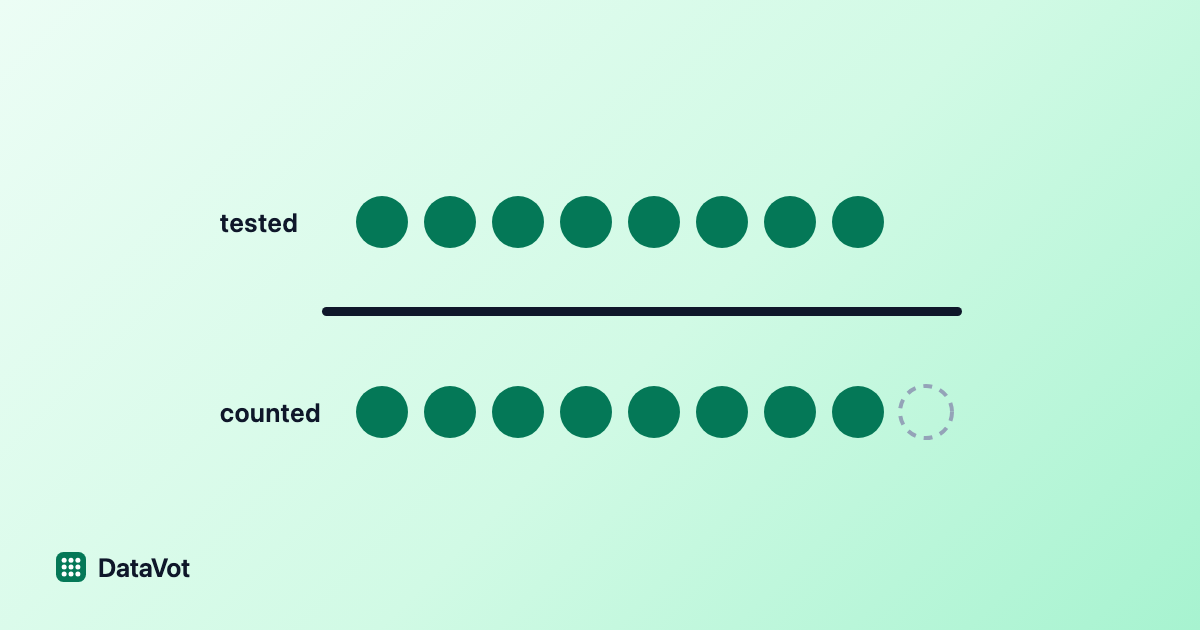
A parent tells the front office that their child will not be taking the NJSLA. Between that phone call and the testing window, somebody has to answer three questions: whether the district loses money, what the school does with the student that morning, and what happens to the data afterward. Those three have very different amounts of documentation behind them, and the first one is easy to get wrong in either direction.
This is for New Jersey district test coordinators, principals, curriculum directors, and the business administrators who get asked the funding question. It is a practitioner's reading of published statutes and guidance, not legal advice.
New Jersey closed the funding question in a single sentence
The belief that a district can lose state aid over participation has been wrong in New Jersey since November 2015. P.L. 2015, c.157, "An Act concerning the withholding of State school aid," was approved on November 9, 2015 and codified at N.J.S.A. 18A:55-2.1. The operative provision is one sentence:
"Notwithstanding the provisions of N.J.S.18A:55-2, or any other law, rule, or regulation to the contrary, the commissioner shall not direct the State treasurer to withhold funds payable by the State to a school district based on the participation rate on any State assessment of the school district's students."
That sentence closes one specific mechanism, the Commissioner of Education directing the State treasurer to withhold money, on one specific basis. It is not a general immunity clause, and it does not reach federal accountability, which runs on separate machinery. But for the question a business administrator asks in a budget meeting, the answer is in the statute, and the answer is no.
Keep the sentence at hand rather than paraphrasing it. A district that believes its aid is at risk will make decisions under that belief, and pressure applied to a family on a false premise is harder to walk back than a wrong number in a spreadsheet.
The federal rule is arithmetic, not a penalty
What still applies is the participation requirement in the Every Student Succeeds Act, at 20 U.S.C. §6311(c)(4)(E). Clause (i) is the part everyone quotes: a state must "Annually measure the achievement of not less than 95 percent of all students, and 95 percent of all students in each subgroup of students, who are enrolled in public schools on the assessments described under subsection (b)(2)(v)(I)."
Clause (ii) does the work, and it is rarely quoted:
"For the purpose of measuring, calculating, and reporting on the indicator described in subparagraph (B)(i), include in the denominator the greater of- (I) 95 percent of all such students, or 95 percent of all such students in the subgroup, as the case may be; or (II) the number of students participating in the assessments."
In practice, a school below the 95 percent line has its achievement indicator calculated against a roster larger than the group that sat the test. Students who did not test stay in the bottom of the fraction and contribute nothing to the top. There is no separate fine and no line item. The shortfall is absorbed into the proficiency figure itself, which is why it can be invisible to anyone reading that figure as a measure of instruction.
How that lands on a particular New Jersey school depends on clause (iii): each state must "Provide a clear and understandable explanation of how the State will factor the requirement of clause (i) of this subparagraph into the statewide accountability system." That explanation lives in New Jersey's own ESSA plan, not in the federal statute, so it is the document to ask NJDOE for if you need the mechanism for your own school. The federal law by itself establishes the denominator rule above.
The state's adaptive guidance does not cover the student who does not test
NJDOE's NJSLA-Adaptive and NJGPA-Adaptive FAQ states who is expected to take the NJSLA-A: "All public school students in required tested grades, including students with disabilities and multilingual learners, consistent with State and federal regulations."
It goes no further. The FAQ covers participation, accommodations, reporting, and, for the NJGPA-A, the alternate pathways open to a student who does not demonstrate graduation readiness. It says nothing about a student whose family refuses, nothing about supervision during the administration, and nothing about an alternate activity. We checked the current FAQ (updated September 23, 2026) for those topics, and they are not there.
So whatever happens in your building on the morning of the test is district policy and nothing else. If it has not been written down, it will be decided at 8:15 by whoever is proctoring, and it will vary by school inside the same district. That makes it a policy question for the board rather than a testing question for a coordinator, and it is much easier to raise in October than in March.
The October 1 notice is a disclosure duty, not a refusal procedure
New Jersey does impose one hard annual obligation here. NJDOE's September 23, 2026 broadcast restates it: under N.J.S.A. 18A:7C-6.6, districts must notify parents and guardians by October 1 of any state assessment or commercially developed standardized assessment that will be administered during the school year. If a district adds a commercially developed assessment later, families get that information within 30 days of the decision. The broadcast lists what the notice must cover, and NJDOE publishes a sample template on its assessment page. For the family's side of that notice, see Questions Parents Should Ask About the NJSLA-Adaptive.
This is a disclosure duty running from the district to the family. It obliges you to say what is coming. It does not establish a refusal, describe one, or supply a procedure for handling one. An October notice that explains "how to opt out" is describing local practice rather than state law, and should be worded so a reader can tell which.
The cost you will actually feel is in the file
A student who does not test has no score, so they add nothing to the count of students tested. A testing coordinator meets the consequences months later, when the results arrive:
- Subgroup cells disappear. Counts that were already close to a reporting threshold can fall under it. A suppressed cell is not a low score; it is the loss of the comparison you wanted to make.
- Year-over-year school comparisons move for non-instructional reasons. If refusals were concentrated in one grade or one building this year and not last, part of the change you see is a change in who sat the test.
- The proficiency figure does not explain itself. Check how your results export records a student who did not test. Whether they are left out or carried with a not-tested code, a proficiency rate read on its own will not tell anyone how many students it leaves out.
Two habits cover most of this. Reconcile the tested roster against the enrolled roster before reading any subgroup result, and carry the participation figure next to the proficiency figure whenever either goes to a board. A proficiency rate shown without its participation rate invites a reading it cannot support.
Nothing requires refusals to be evenly distributed. They can cluster by grade or by building. When they do, a district-level participation figure can look untroubled while one school sits well below the line. The denominator effect then lands hardest on the schools with the smallest subgroups, where a handful of students was already the difference between a reportable cell and a suppressed one. The district number will barely move. The school number can move enough to change what a board sees, which is why the participation figure has to travel with it.